
“Because you [Ammon—Northern Jordan] have clapped your hands and stamped your feet, rejoicing with all the malice of your heart against the land of Israel, therefore I will stretch out my hand against you and give you as plunder to the nations.” (Ezekiel 25:6–7)
Last week, after Israeli soldiers killed a Jordanian judge at the Allenby Bridge border crossing, Jordan’s parliament threatened to topple the Jordanian government if it did not remove the Israeli ambassador and recall Jordan’s ambassador to Israel.
Yesterday, Jordanian Prime Minister Abdullah Ensour escaped a no-confidence vote by Jordan’s parliament.
He told the parliamentarians that the government “does not see that expelling the Israeli envoy and recalling the Jordanian ambassador serve the path of our martyr’s case.” (Times of Israel)

Jordanian Prime Minister Abdullah Ensour
A preliminary IDF report said that Raed Za’eiter was killed after he tried to steal a guard’s rifle and attacked Israeli soldiers with a metal pole.
It described Za’eiter as ignoring warnings and commands to desist from his attack on the Israeli border guards before the shooting.
The attack began after bus passengers from Jordan disembarked for examination by two security guards. It is reported that Za’eiter attacked one of the guards with the long iron rod that is used to check under buses for explosives.
The driver and some of the passenger testified that Za’eiter attacked first and that his actions were not preceded by violence on the part of the soldiers.
Acting according to the rules of engagement, one soldier fired at Za’eiter’s feet while the other shot at his legs. As the altercation continued Za’eiter was also hit in his upper body. While eight bullet casings were found at the scene, Za’eiter was hit five times.
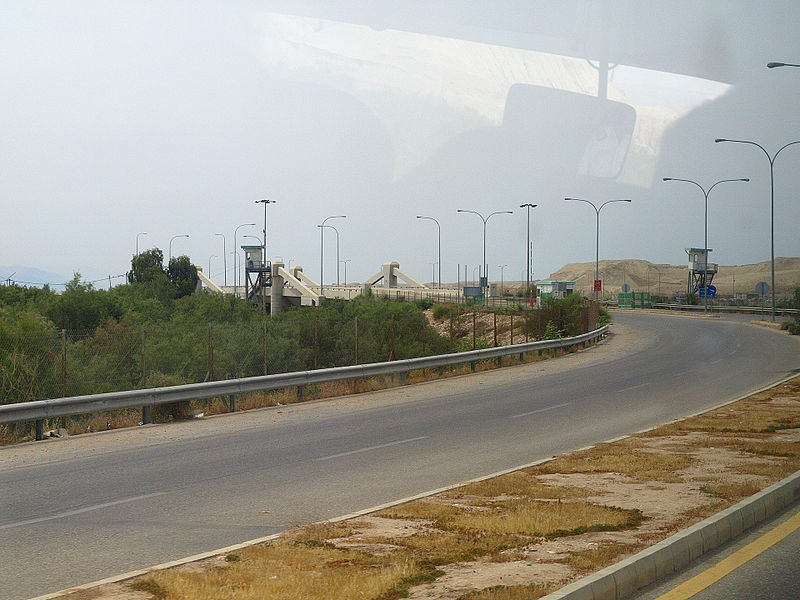
Approaching the Allenby/King Hussein Bridge from the Jordanian side: this bridge crosses the Jordan River and connects the West Bank with Jordan.
Because Za’eiter was a Jordanian, Prime Minister Benjamin Netanyahu issued a formal statement of sympathy to the Jordan people and government.
“Israel regrets the death of judge Raed Za’eiter yesterday at the King Hussein [Allenby] Bridge and expresses its sympathies to the people and government of Jordan,” the statement said.
“In light of our commitment to the peace treaty, Israel has already shared with Jordan the results of its preliminary investigation of the incident,” the statement continued. “Israel has also agreed to a Jordanian request to establish a joint Israeli-Jordanian team to complete the investigation.”
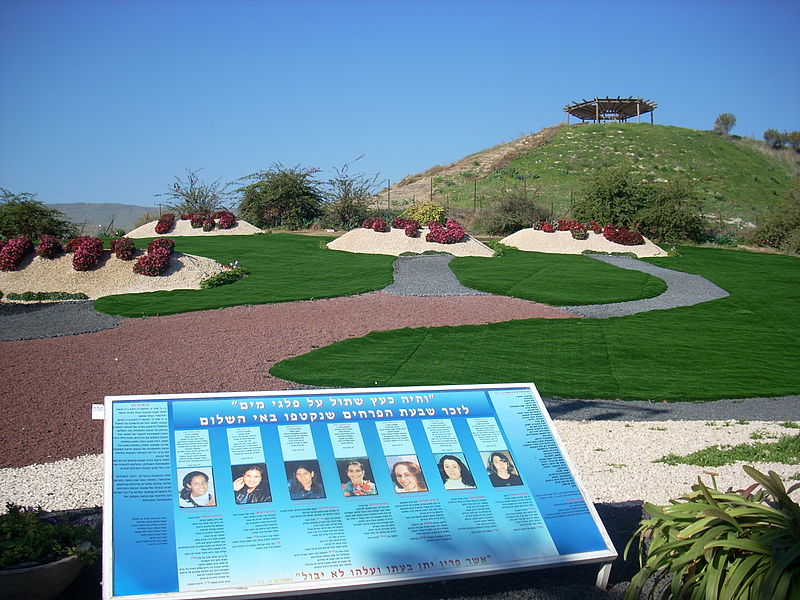
A memorial to the seven schoolgirls who were killed by a Jordanian guard on March 13, 1997, after they mocked him while he was praying. The girls were on a school field trip to the joint Israeli -Jordan tourist resort under Jordanian rule when the guard opened fire with an M-16 rifle, intending to kill everyone on the bus. He couldn’t because his gun jammed. He was hailed a “hero” by the Jordanian Justice Minister and parliament.
Still, last week, a 2,000 strong crowd organized by the Muslim Brotherhood demonstrated in front of the Israeli embassy in Amman calling on King Abdullah II to annul the 1994 peace treaty with Israel.
Additionally, Jordan’s parliament demanded the release of all Palestinian and Jordanian prisoners from Israel’s jails, as well as the release of Ahmed Daqamseh, the former Jordanian border guard who killed seven Israeli schoolgirls in 1997 at the Island of Peace (Naharayim) border crossing. In that attack, he also wounded five others, including a teacher. (JPost)
Despite the public expression of solidarity for Daqamseh, who was sentenced to several consecutive life sentences for his crime, it is unlikely that King Abdullah will pardon him. As well, the Jordanian Prosecutor’s Office has not pushed the pardon process forward, though 110 of the 120 members of Jordan’s House of Representatives have signed a petition demanding a pardon.